Banner

About the Journal

Founded in 2025, AI & Antiquity: Journal of Teaching and Technology in Ancient Studies (ISSN 3081-4553) provides a peer-reviewed, open-access forum dedicated to the study of Antiquity through innovative, inclusive, and pedagogically focused approaches.

The journal brings together history, archaeology, philology, and related disciplines with digital humanities, artificial intelligence, and educational research. Its primary aim is to place teaching and learning at the centre of scholarly discussion while maintaining rigorous academic standards.

From 2026 onwards, AI & Antiquity is published biannually (February and September). All articles are double-blind peer-reviewed and published without submission fees or article processing charges (APCs).

Current Issue

Volume 1, Issue 1 (2025)
					View Volume 1, Issue 1 (2025)

The inaugural issue of AI & Antiquity: Journal of Teaching and Technology in Ancient Studies launches the journal’s mission to explore the intersections of artificial intelligence, inclusive pedagogy, and ancient studies. This foundational volume gathers the proceedings of the First International Conference on Innovation and Technology in Ancient History Education, held online in May 2025 and hosted by the Universitat Autònoma de Barcelona.

The contributions reflect a broad range of perspectives, from digital epigraphy and ancient language learning to inclusive teaching, rhetorical practice, and the representation of gender and diversity in antiquity. Together, they highlight both the challenges and the opportunities posed by the rapid spread of generative AI in higher education, showing how ancient studies can play a leading role in rethinking teaching for the 21st century.

We also acknowledge with gratitude the work of peer reviewers, the members of the advisory and editorial boards, and the participating institutions, whose support has made this inaugural volume possible. This issue marks the beginning of a scholarly space dedicated to fostering critical dialogue, pedagogical innovation, and inclusive practices across the global community of ancient world studies.

Full Issue available in PDF:
Download PDF

Published: 2025-09-24

Editorial

  • Opening the Conversation: Rethinking How We Teach Antiquity in the Age of AI

    Carlos Heredia Chimeno (Author)
    4-14
    DOI: https://doi.org/10.64946/aiantiquity.v1i1.editorial

Articles

  • Epigrafía Digital e Inteligencia Artificial: preguntas y respuestas de una experiencia docente

    Cristina de la Escosura Balbás, Elena Duce Pastor (Author)
    15-34
    DOI: https://doi.org/10.64946/aiantiquity.v1i1.001
  • Navigating the Fog: The Effectiveness of Personalised Conversational GenAI Models for Supporting Ancient Language Learning

    Edward A. S. Ross, Jackie Baines (Author)
    35-52
    DOI: https://doi.org/10.64946/aiantiquity.v1i1.002
  • Cicerón en el aula digital: IA y la oratoria clásica como herramienta didáctica

    Marco Almansa Fernández (Author)
    53-66
    DOI: https://doi.org/10.64946/aiantiquity.v1i1.003
  • AI Applications for Ancient Art History Education

    Caitlan Smith (Author)
    67-92
    DOI: https://doi.org/10.64946/aiantiquity.v1i1.004
  • Tecnologías emergentes aplicadas a la enseñanza de la Historia Antigua: una propuesta metodológica basada en IA generativa y modelos 3D

    Gerard Cabezas Guzmán, Anna Rovira Marcelino (Author)
    93-103
    DOI: https://doi.org/10.64946/aiantiquity.v1i1.005
  • Grècia viral: Xarxes Socials i divulgació en l’ensenyament de la història de Grècia

    Marc Mendoza (Author)
    104-114
    DOI: https://doi.org/10.64946/aiantiquity.v1i1.006
  • Inteligencia Artificial y representaciones del pasado: estrategias docentes para visibilizar la diversidad de género y sexual en las culturas antiguas

    Cristina Vidal Lorenzo, Mireia López-Betran, Mª Luisa Vázquez de Ágredos-Pascual, Patricia Horcajada Campos, Núria Feliu Beltrán, Esther Parpal Cabanes, Vanesa García López de Andújar (Author)
    115-134
    DOI: https://doi.org/10.64946/aiantiquity.v1i1.007
View All Issues
Call for Papers

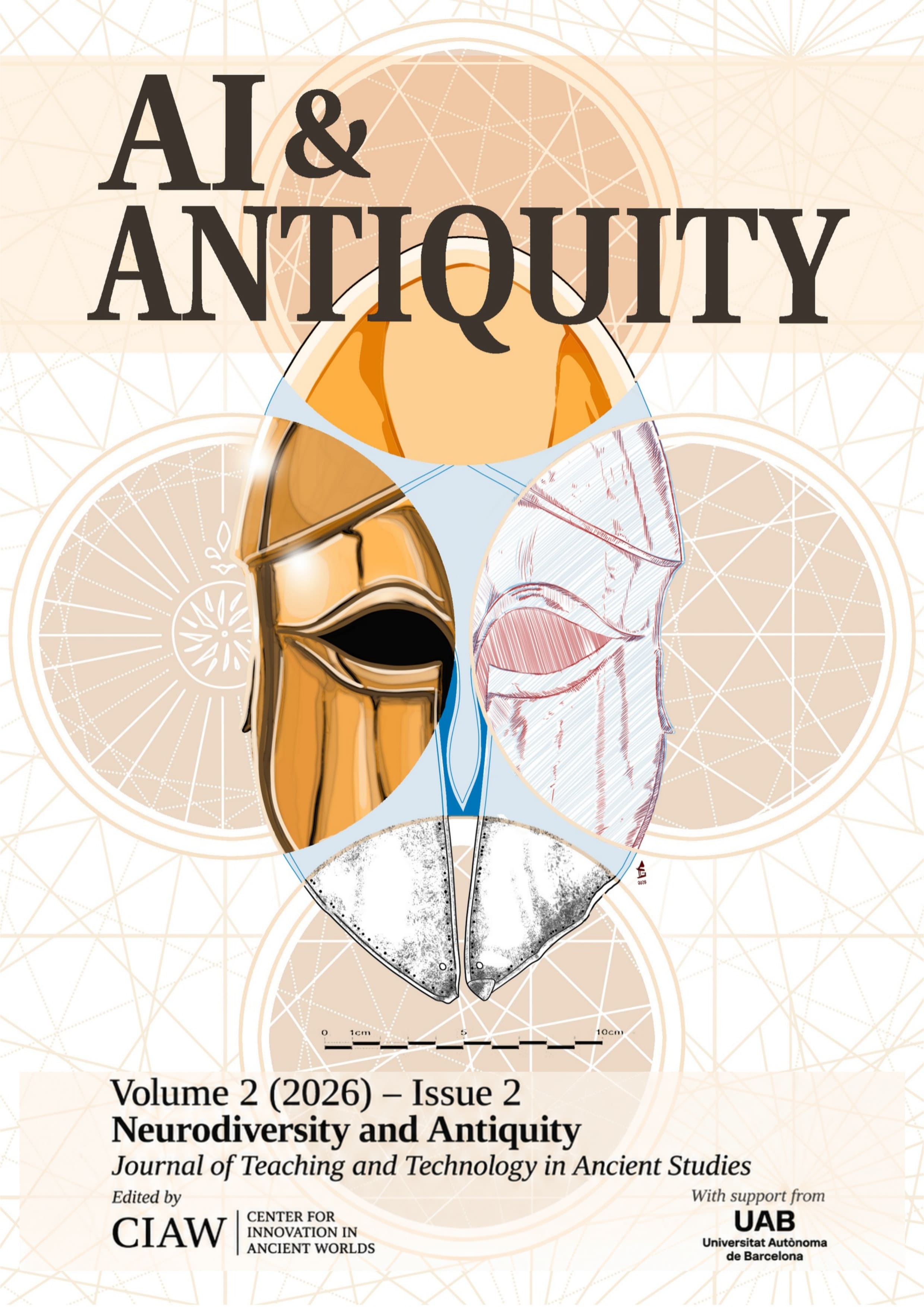
Volume 2, Issue 2 (September 2026) — Neurodiversity & Ancient History Education

Submission deadline: May 15, 2026 Publication: September 2026 Theme: Neurodiversity & Inclusive Pedagogy

The journal invites contributions for its second volume (Issue 2), to be published in September 2026. This issue will be devoted exclusively to neurodiversity and its application to Ancient History and Classical Studies, exploring how neurodivergent perspectives can transform both the teaching and understanding of the ancient world.

Submit a Manuscript Read Editorial Guidelines

We welcome submissions from scholars, educators, and practitioners engaging with inclusive, neurodivergent-aware approaches to learning, research, and communication in Ancient Studies. Contributions may address theoretical, methodological, or practical aspects of neurodiversity in academic, digital, or outreach contexts.

Topics of Interest

Neurodivergent perspectives on teaching, learning, and researching Antiquity
Inclusive pedagogy and Universal Design for Learning (UDL) in Ancient Studies
The role of AI and digital tools in supporting neurodiverse learning environments
Sensory and emotional dimensions of historical learning
Cognitive diversity in interpreting ancient texts, art, and material culture
Case studies on classroom innovation or digital accessibility in Ancient History
Reflections on personal experience and academic practice

Submission Formats

In addition to research articles, we welcome reflective essays, teaching reports, and reviews of books, platforms, or pedagogical tools that advance inclusive and neurodiversity-oriented approaches to the Ancient World.

Important Dates

  • Full paper submission deadline: May 15, 2026
  • Publication date: September 2026

Ready to Submit?

For formatting requirements and ethical AI disclosure, please consult our Editorial Guidelines. We look forward to receiving your contributions and to building a dynamic, inclusive community dedicated to reshaping the future of Ancient Studies education.

Submit Now Contact the Editors

Supported by: the innovation project “Voces olvidadas en la Antigüedad: docencia inclusiva y pensamiento crítico en tiempos de inteligencia artificial” (“Forgotten Voices in Antiquity: Inclusive Teaching and Critical Thinking in Times of Artificial Intelligence”) (Universitat Autònoma de Barcelona, Teaching Innovation Project – Modalitat A, GI517492), led by Carlos Heredia and Isaías Arrayás.