Archives
-
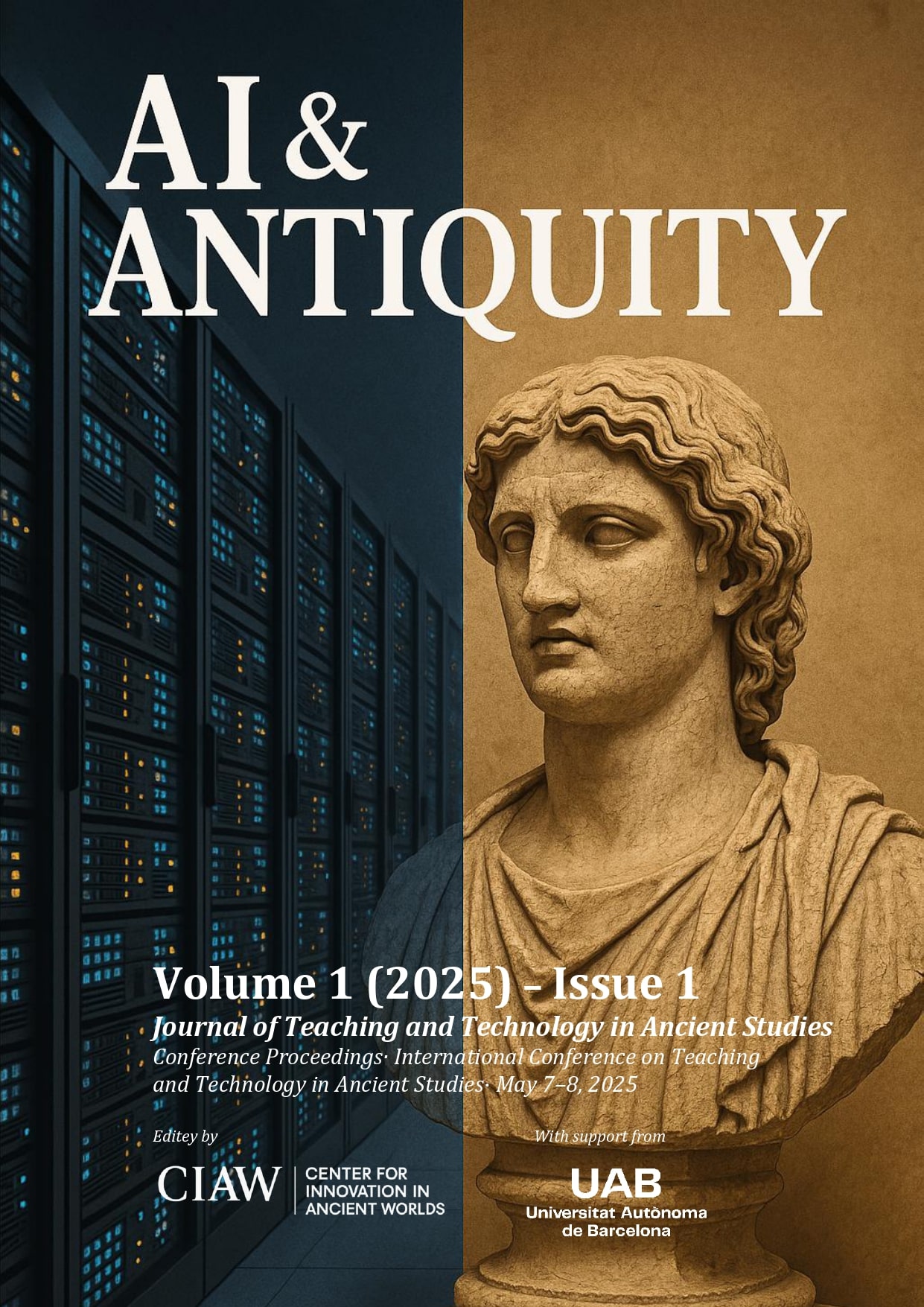
Volume 1, Issue 1 (2025)
The inaugural issue of AI & Antiquity: Journal of Teaching and Technology in Ancient Studies launches the journal’s mission to explore the intersections of artificial intelligence, inclusive pedagogy, and ancient studies. This foundational volume gathers the proceedings of the First International Conference on Innovation and Technology in Ancient History Education, held online in May 2025 and hosted by the Universitat Autònoma de Barcelona.
The contributions reflect a broad range of perspectives, from digital epigraphy and ancient language learning to inclusive teaching, rhetorical practice, and the representation of gender and diversity in antiquity. Together, they highlight both the challenges and the opportunities posed by the rapid spread of generative AI in higher education, showing how ancient studies can play a leading role in rethinking teaching for the 21st century.
We also acknowledge with gratitude the work of peer reviewers, the members of the advisory and editorial boards, and the participating institutions, whose support has made this inaugural volume possible. This issue marks the beginning of a scholarly space dedicated to fostering critical dialogue, pedagogical innovation, and inclusive practices across the global community of ancient world studies.
Full Issue available in PDF:
Download PDF -
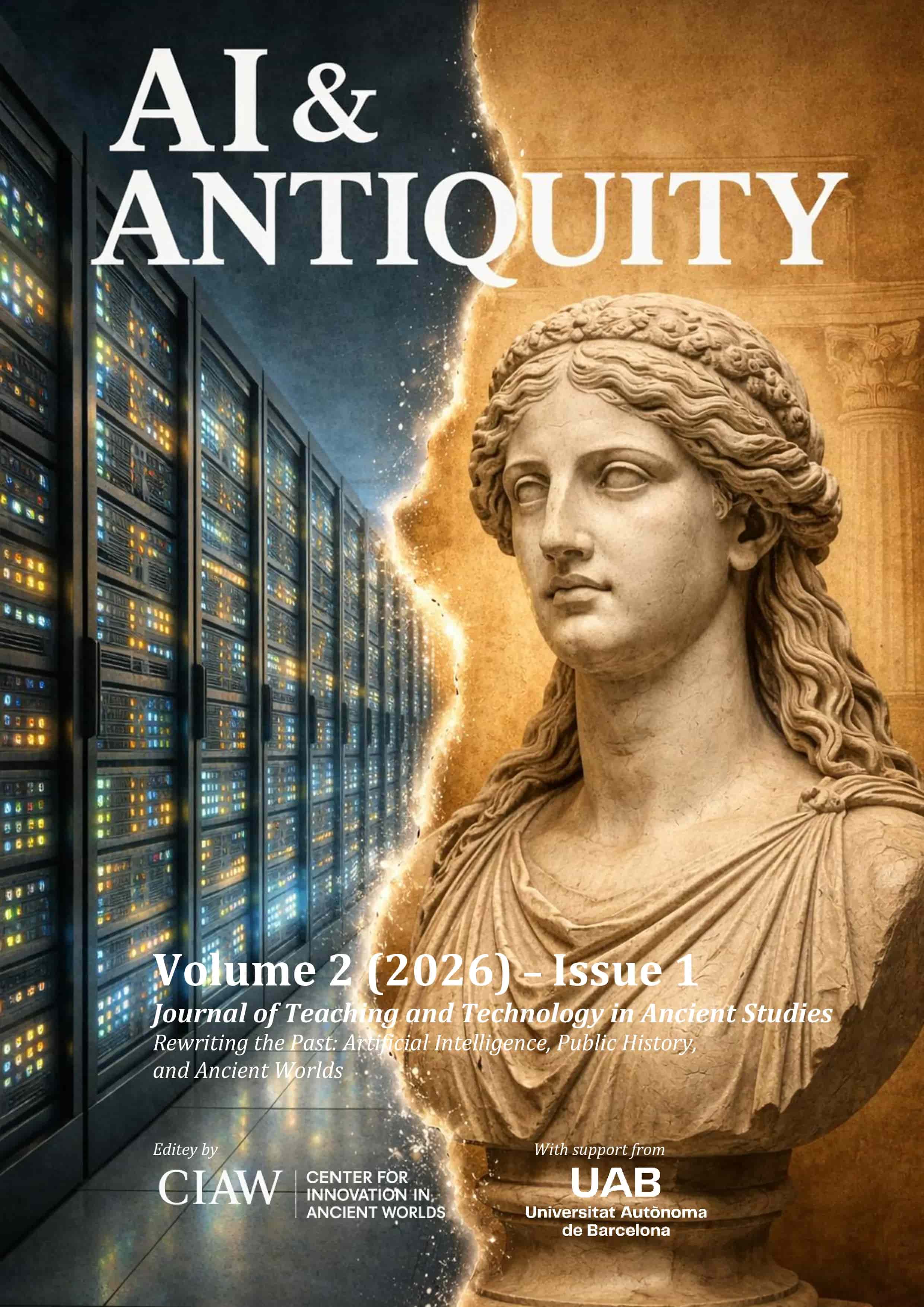
Volume 2, Issue 1 (2026)
Volume 2, Issue 1 (2026) of AI & Antiquity explores the shifting epistemic landscape of Ancient Studies in an era increasingly mediated by artificial intelligence. Moving beyond celebratory or alarmist narratives, this issue addresses AI as a site of negotiation—between pedagogy and research, automation and responsibility, innovation and scholarly trust.
The contributions gathered here examine AI as a cognitive mediator in the classroom, as a methodological tool in historical research, and as a force shaping cultural memory and historiographical inclusion. From practical case studies on responsible classroom implementation to comparative evaluations of generative AI in primary source analysis, the issue foregrounds verification, reflexivity, and critical literacy as core scholarly competencies. It also expands the debate toward public history and heritage discourse, asking how algorithmic systems influence representation, authority, and the recovery of historically marginalised voices.
Particular attention is given to emerging structural challenges, including bibliographic hallucinations, the transformation of editorial responsibility in AI-assisted academic environments, and the weaponisation of generative systems for reputational harm. The volume addresses the use of AI-generated content to fabricate citations, misattribute authorship, or produce defamatory narratives about scholars as a form of academic bullying that operates through technological mediation. Rather than treating such practices solely as individual misconduct, the issue situates them within broader questions of platform governance, verification protocols, and institutional accountability.
Rather than framing technological irregularities as moral failures, this volume advocates for shared institutional adaptation, methodological vigilance, transparent pedagogical practice, and clear ethical frameworks capable of responding to both epistemic and interpersonal risks introduced by AI.
Structured as a coherent itinerary—from mediation to method, from method to memory, and from memory to inclusion—Volume 2, Issue 1 invites scholars, educators, and institutions to engage critically with AI not as a peripheral tool, but as a transformative condition of contemporary knowledge production in Ancient Studies.
Full Issue available in PDF:
Download PDF