Teaching Guides
A collection of research-informed teaching resources supporting educators and institutions in the development of more inclusive, accessible, and neurodiversity-aware learning environments. Developed through research and teaching practice in Ancient History and Classical Studies, these guidelines translate pedagogical evidence into adaptable strategies for curriculum design, classroom practice, assessment, and responsible AI integration across disciplines.
Teaching Guidelines
Evidence-informed frameworks addressing inclusive curriculum design, cognitive accessibility, multimodal learning, flexible assessment, Universal Design for Learning, and critical approaches to Artificial Intelligence in education.
Shareable Infographics
Accessible visual resources designed for teaching workshops, professional development, academic discussions, and institutional innovation initiatives. The infographics were developed through a combination of Canva Pro and NotebookLM, using project-funded licences to support the creation of inclusive, research-informed educational materials. These resources were produced within the framework of the UAB Teaching Innovation Project “Voces olvidadas en la Antigüedad: docencia inclusiva y pensamiento crítico en tiempos de inteligencia artificial” (Universitat Autònoma de Barcelona – Modalitat A, GI517492), directed by Carlos Heredia and Isaías Arrayás.
Three Complementary Guidelines
The following resources present complementary approaches to inclusive teaching, critical engagement with Artificial Intelligence, and responsible knowledge practices in Higher Education.
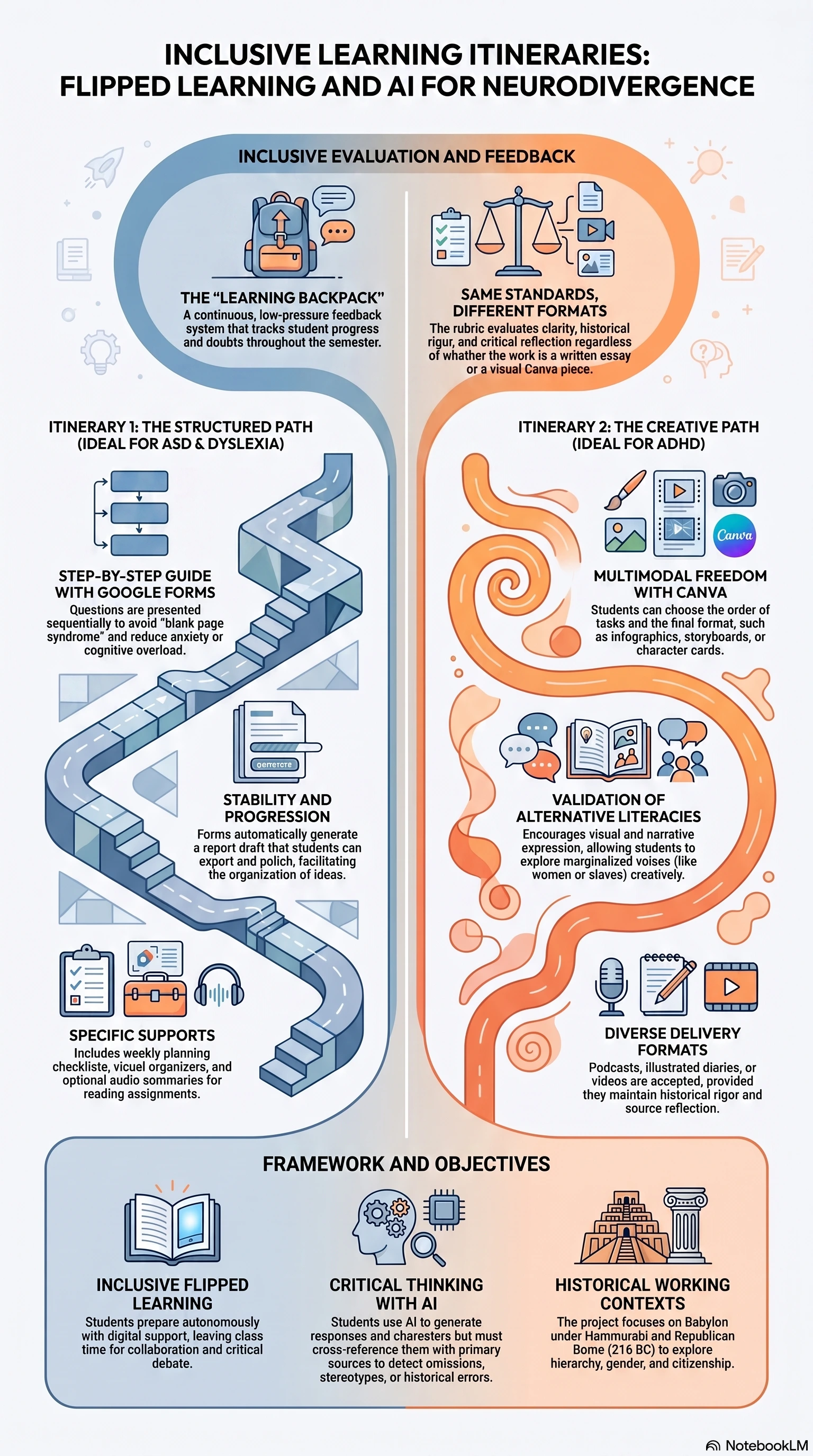
This guideline presents an adaptable framework for combining flipped learning, Artificial Intelligence, and inclusive instructional design in Higher Education. Originally developed through Ancient History teaching, it provides transferable strategies for supporting diverse learners while maintaining academic standards, disciplinary accuracy, and critical engagement with knowledge.
The framework can be adapted to different subjects by modifying learning materials, classroom activities, sources, and assessment methods according to disciplinary objectives and institutional contexts.
Key Teaching Principles
- Inclusive flipped learning: Students engage with accessible materials before class, allowing classroom time to focus on discussion, collaboration, interpretation, problem-solving, and disciplinary reasoning.
- Critical AI literacy: Artificial Intelligence is used as a tool for questioning, comparing, analysing, and improving understanding rather than replacing disciplinary expertise or academic judgement.
- Critical enquiry: Learning activities encourage students to examine evidence, perspectives, assumptions, and debates within each discipline.
Flexible Learning Pathways
- Structured pathway: Guided sequences, visual organisers, explicit instructions, and planning tools support learners who benefit from greater structure and reduced cognitive overload.
- Creative pathway: Flexible formats allow students to demonstrate disciplinary understanding through different forms of communication, including written work, presentations, podcasts, videos, infographics, or digital projects.
Inclusive Assessment
- Continuous feedback: Learning portfolios, reflective activities, and formative assessment support students in monitoring their progress throughout the learning process.
- Equivalent academic expectations: Assessment focuses on knowledge, reasoning, evidence use, and argumentation while allowing different pathways for communicating learning.
Possible Uses
- Redesigning modules through inclusive flipped learning approaches.
- Developing AI literacy activities within disciplinary teaching.
- Creating accessible pre-class materials and classroom activities.
- Designing workshops on inclusive teaching methodologies.
- Supporting curriculum innovation projects across disciplines.
Recommended citation
Center for the Innovation in Ancient Worlds & Heredia Chimeno, C. (2026). CIAW Teaching Infographics: Inclusive Learning, Critical AI Literacy, and Responsible Knowledge Practices [Infographic: Inclusive Learning Itineraries: Flipped Learning and AI for Neurodivergence]. Zenodo. https://doi.org/10.5281/zenodo.21763472
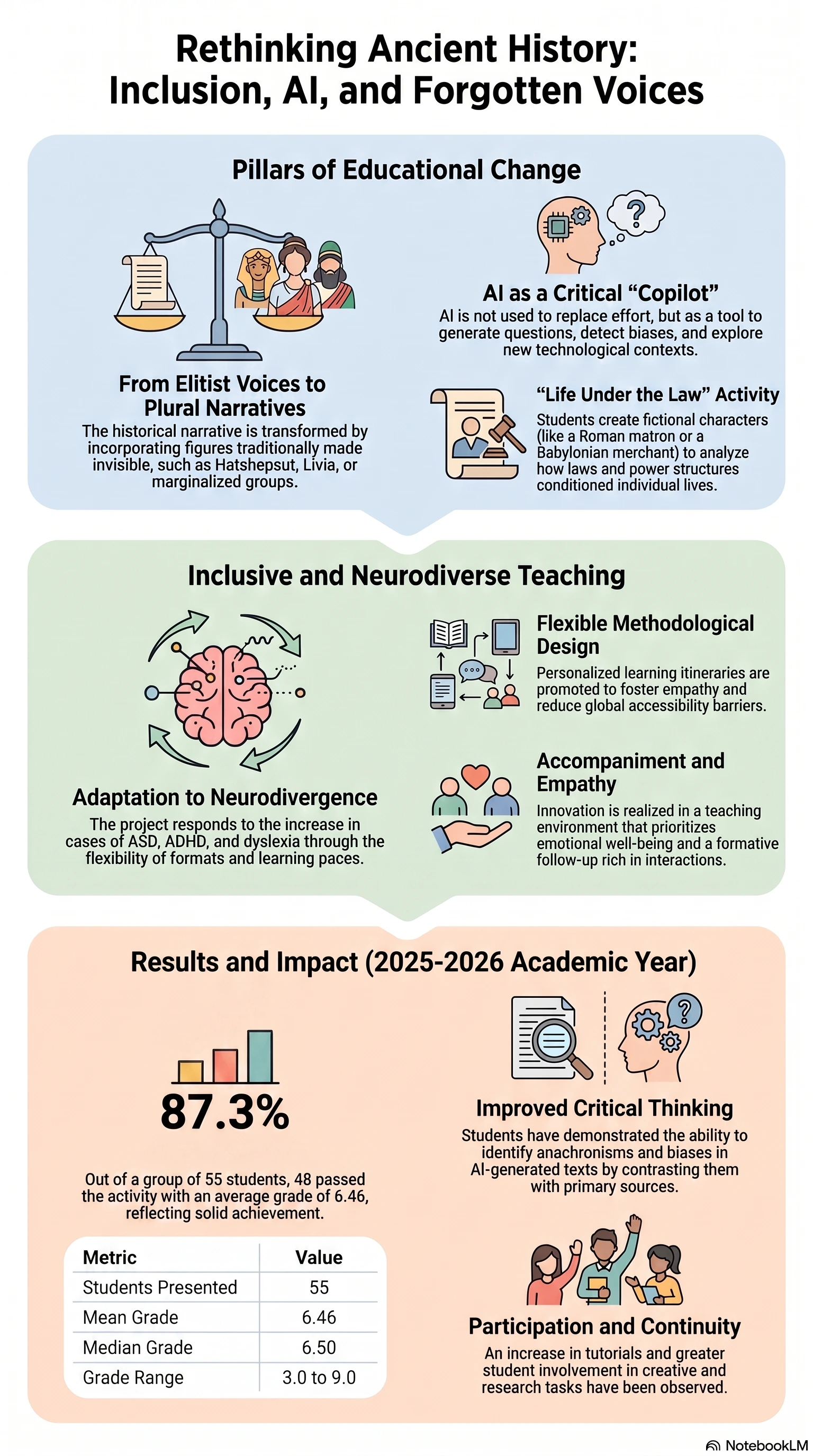
This guideline presents an approach to teaching that combines inclusive perspectives, neurodiversity-aware practices, and responsible Artificial Intelligence use. It encourages educators to move beyond single narratives by incorporating diverse experiences, viewpoints, and forms of knowledge into classroom activities and disciplinary discussions.
Originally developed through historical enquiry, the framework can be transferred to different subjects by adapting examples, sources, learning activities, and discussion formats according to each discipline's objectives and traditions.
Principles for Transforming Learning
- From a single narrative to multiple perspectives: Students explore different viewpoints, experiences, and forms of knowledge rather than relying exclusively on dominant or established interpretations.
- AI as a critical learning partner: AI-generated materials become opportunities to analyse assumptions, inaccuracies, limitations, stereotypes, and methodological challenges.
- Connecting knowledge and experience: Teaching activities explore how ideas, structures, institutions, and social contexts shape the experiences of individuals and communities.
Inclusive Classroom Design
- Multiple ways of engaging: Flexible learning activities allow students to access, analyse, and communicate knowledge through different approaches and formats.
- Accessible methodologies: Clear expectations, flexible pathways, and supportive resources help reduce barriers while maintaining disciplinary standards.
- Supportive learning environments: Dialogue, feedback, and empathy contribute to learning spaces where diverse students can participate meaningfully.
Learning Outcomes
- Critical thinking: Students develop the ability to evaluate information, including AI-generated content, through evidence, disciplinary methods, and academic standards.
- Inclusive participation: Flexible approaches encourage engagement from learners with different experiences, strengths, and learning profiles.
- Expanded disciplinary perspectives: Students learn to recognise complexity, uncertainty, and multiple viewpoints within knowledge production.
Possible Uses
- Curriculum redesign focused on inclusion and representation.
- Teaching workshops on diversity, accessibility, and inclusive methodologies.
- Activities exploring perspectives, assumptions, and knowledge construction.
- Staff development sessions on responsible AI integration.
- Interdisciplinary discussions about inclusive approaches to learning.
Recommended citation
Center for the Innovation in Ancient Worlds & Heredia Chimeno, C. (2026). CIAW Teaching Infographics: Inclusive Learning, Critical AI Literacy, and Responsible Knowledge Practices [Infographic: Rethinking Ancient History: Inclusion, AI, and Forgotten Voices]. Zenodo. https://doi.org/10.5281/zenodo.21763472
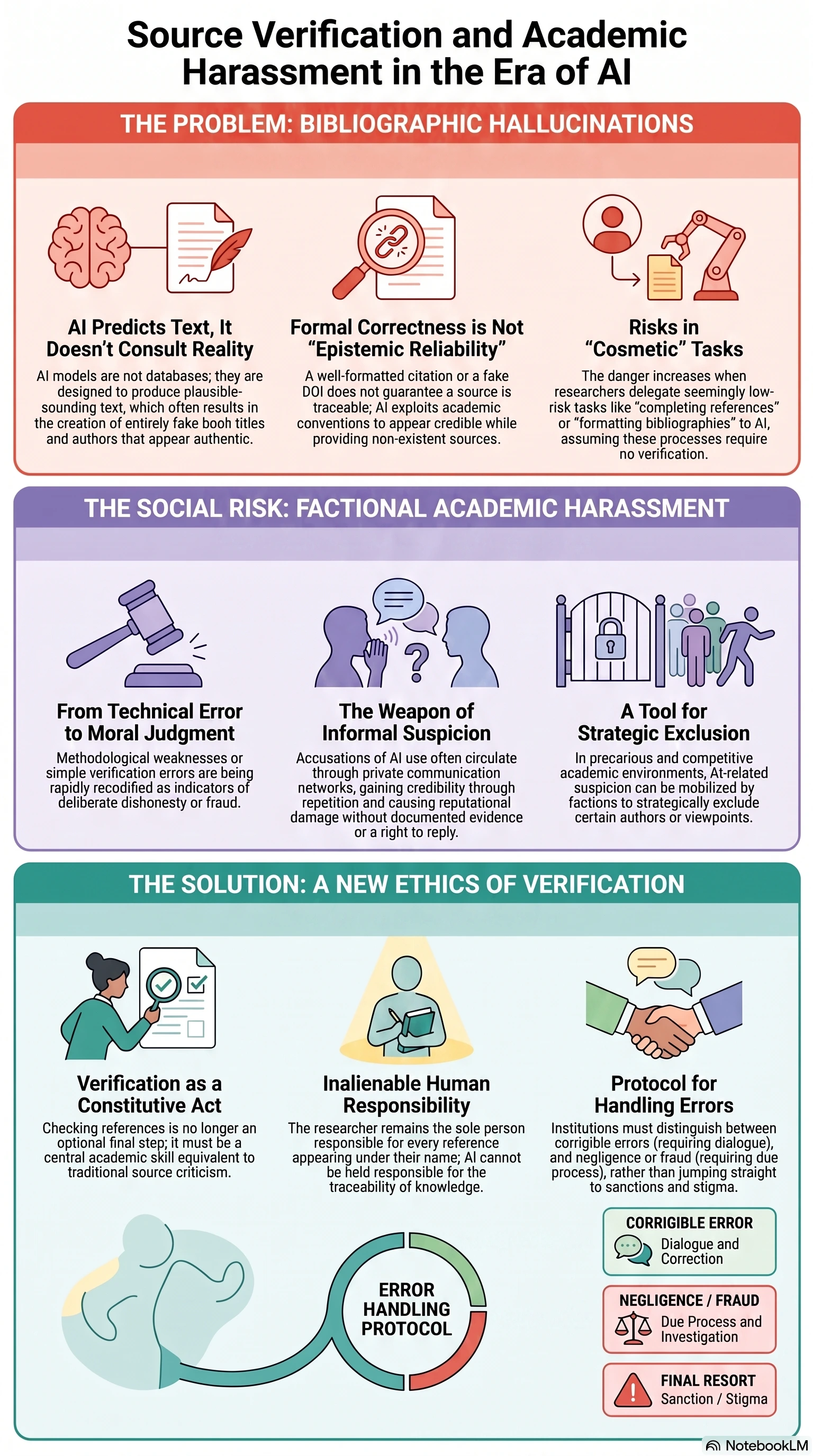
This guideline provides educators and researchers with a framework for addressing Artificial Intelligence verification, academic integrity, and responsible evaluation practices in Higher Education. It focuses on evidence-based verification, transparency, methodological judgement, and the prevention of AI-related accusations becoming instruments of harassment, reputational damage, or factional conflicts within research communities.
Rather than assuming that the presence or alleged use of Artificial Intelligence represents academic misconduct, this approach emphasises that AI-related concerns must be examined through reliable evidence, transparent procedures, and disciplinary standards. Verification should strengthen academic integrity, not become a mechanism for personal attacks, professional exclusion, or conflicts between competing groups of researchers.
Understanding the Challenges
- AI use and unsupported accusations: Claims that researchers have used Artificial Intelligence improperly require evidence and contextual analysis. Assumptions based only on writing style, productivity, or personal disagreements may lead to unfair judgments.
- Limits of detection methods: AI detection tools may produce uncertain results and should not be treated as definitive proof of misconduct without additional verification, scholarly review, and examination of research practices.
- Academic conflicts and reputational harm: In environments marked by competing schools, institutions, or research factions, allegations of AI use may become tools for undermining colleagues rather than improving research standards.
Developing Critical AI Verification Literacy
- Verification as a core academic skill: Researchers and students should learn to evaluate sources, references, arguments, data, writing processes, and methodological decisions rather than relying on suspicion or automated judgements.
- Transparent AI practices: Academic communities should promote clarity about when, why, and how AI tools are used in research, teaching, writing, and analysis.
- Critical evaluation of evidence: AI-related concerns should distinguish between acceptable assistance, methodological weaknesses, accidental errors, and intentional misuse.
Guidance for Educators and Researchers
- Prioritise evidence-based review: Evaluate possible AI misuse through research documentation, sources, drafts, methodology, citations, and scholarly practices rather than isolated indicators.
- Promote fair academic dialogue: Address concerns through discussion, peer review, and institutional procedures instead of public accusations or harassment campaigns.
- Protect research communities: Encourage environments where disagreement about methods, theories, or interpretations does not become confused with evidence of AI misconduct.
Possible Uses
- Developing institutional frameworks for transparent AI verification practices.
- Training researchers and educators to evaluate AI-related claims responsibly.
- Creating guidelines that distinguish academic integrity concerns from interpersonal or factional conflicts.
- Supporting workshops on AI literacy, evidence evaluation, and responsible scholarly communication.
- Designing fair procedures for addressing suspected inappropriate AI use.
Recommended citation
Center for the Innovation in Ancient Worlds & Heredia Chimeno, C. (2026). CIAW Teaching Infographics: Inclusive Learning, Critical AI Literacy, and Responsible Knowledge Practices [Infographic: Source Verification and Academic Harassment in the Era of AI]. Zenodo. https://doi.org/10.5281/zenodo.21763472
Using and Adapting These Resources
These guidelines and infographics are designed as open educational resources to support teaching innovation, professional development, and collaborative reflection across disciplines. They can be adapted to different subjects, institutional contexts, and learner communities according to local needs and educational objectives.
Educators and institutions are encouraged to reuse, discuss, and extend these materials while acknowledging the original project, publications, and authors.
Suggested Applications
- Curriculum redesign and course development.
- Teaching workshops and professional development activities.
- Departmental discussions on inclusive pedagogy and AI literacy.
- Collaborative projects on educational innovation.
By connecting inclusive methodologies, critical approaches to technology, and disciplinary expertise, these resources contribute to more accessible, reflective, and innovative approaches to teaching and learning.